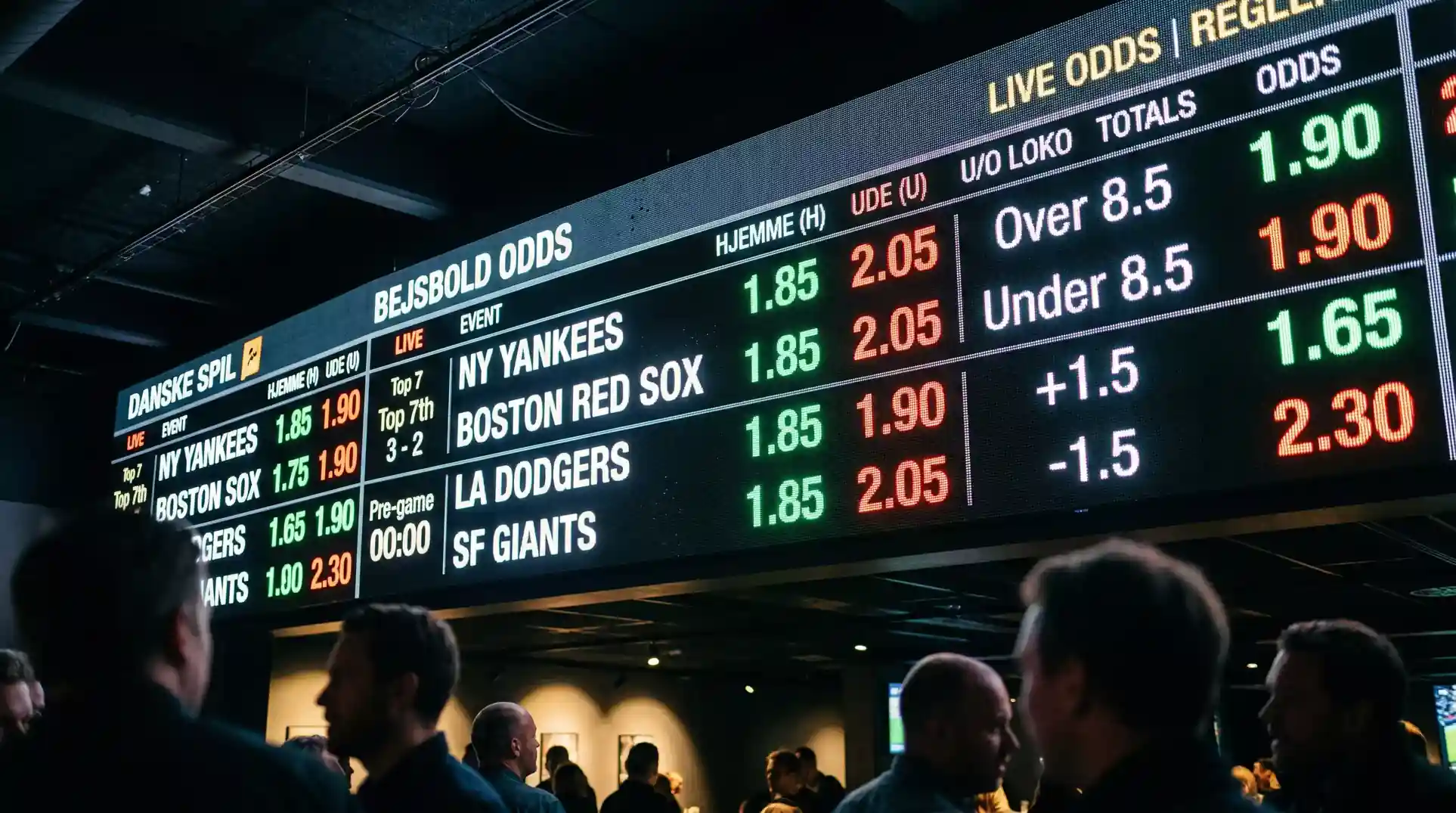
MLB Betting Statistics: Data-Driven Tools for Baseball Wagering
 Available in US
Table of Contents
- Analyzing Key MLB Betting Statistics for Market Value
- MLB’s Place in the US and UK Betting Landscape
- Traditional Stats vs Advanced Metrics: What Actually Predicts Outcomes
- Reading the Market: Public Money, Sharp Money, and Consensus Splits
- MLB Betting Trends That Move the Needle
- Park Factors and Environmental Variables
- Player Props: The Fastest-Growing MLB Betting Segment
- Integrity, Regulation, and the Prediction Market Question
- From Metric to Wager: A Practical Workflow
- Turn the numbers into the wager
- Common Statistical Traps in MLB Betting
- Frequently Asked Questions About MLB Betting Statistics

Nine years ago, I placed my first MLB wager on a gut feeling. The starting pitcher “looked sharp” in his last outing, the team was on a hot streak, and a mate swore the over was a lock. I lost. The next day I lost again. By the end of that first month, I had a negative ROI, a spreadsheet full of emotions, and zero understanding of why baseball odds moved the way they did.
What changed everything was a single question: what do the numbers actually say? Not the broadcast graphics or the back-of-the-baseball-card stats that everyone already prices in, but the deeper data — the metrics sportsbooks sometimes lag behind, the market signals most bettors never read, the environmental variables that shift a total by a full run. Once I started treating MLB wagering as a data problem rather than a prediction game, the losses slowed, the edge sharpened, and the process became something I could repeat night after night across a 162-game grind.
That grind is also getting bigger. US sports betting revenue hit $16.96 billion in 2025, a 22.8% jump from the prior year, and MLB accounts for roughly 15% of the total handle. Across 38 states with legal sportsbooks, baseball now generates more betting action than at any point in the sport’s history. And this is not an American-only story — the UK market is growing alongside it, with bettors increasingly looking west for value in a sport that rewards statistical discipline more than any other.
$16.96B
US sports betting revenue in 2025
15%
MLB’s share of total US betting handle
38
US states with legal sportsbooks
162
Regular season games per team — the longest data set in major sport
This guide is built from nearly a decade of tracking lines, building models, and making mistakes expensive enough to learn from. It covers every layer of MLB betting statistics — from the market-level numbers that frame the industry, through the sabermetric metrics that identify mispriced lines, down to the practical workflows that turn data into wagers. Whether you are placing your first baseball bet or refining a process that already works, the numbers in these pages are the foundation everything else sits on.
Analyzing Key MLB Betting Statistics for Market Value
- MLB accounts for 15% of the $166.94 billion US sports betting handle, with league revenue hitting a record $12.1 billion — making baseball the deepest statistical market in sport.
- Advanced metrics like FIP, wOBA, and BABIP outpredict traditional stats for betting purposes because they isolate player skill from luck, defence, and sequencing.
- Home underdogs won 45.9% of games in 2025, making them the most structurally reliable trend in baseball wagering.
- Sharp money signals — particularly divergences between ticket count and handle percentage — reveal where professional bettors are positioned before the line moves.
- Park factors and same-day weather data shift totals by a full run or more, yet remain under-checked by the majority of bettors.
MLB’s Place in the US and UK Betting Landscape
I spent the first three years of my betting career ignoring market context entirely. I did not care how much money flowed through MLB markets, which operators dominated which regions, or how the industry’s growth affected the lines I was betting into. That was a mistake. Understanding where baseball sits inside the broader wagering economy tells you something critical about liquidity, line efficiency, and where soft spots survive.
The US legal sports betting market processed $166.94 billion in total wagers during 2025 — an 11% increase year over year. Since the Supreme Court struck down PASPA in 2018, more than $600 billion has been legally wagered on sports across the country. Bill Miller, president of the American Gaming Association, framed it plainly: “These record revenues and tax contributions demonstrate the broad appeal of regulated gaming markets and why strong state oversight remains essential as our industry evolves.” Baseball’s slice of that total sits at approximately 15% of handle, trailing the NFL and basketball but growing steadily as prop markets and in-play wagering expand the menu of available bets.
MLB itself is having a financial moment that feeds directly into betting interest. League revenue reached a record $12.1 billion for the 2024 fiscal year, up $500 million from 2023. Stadium attendance cleared 71 million for the season — the highest since 2017 — and streaming viewership on MLB.TV climbed from 12.7 billion minutes in 2023 to 14.5 billion minutes in 2024. More eyeballs mean more bettors, and more bettors mean tighter lines on marquee matchups but also overlooked value on the Tuesday night games nobody is watching.
The Los Angeles Dodgers became the first franchise in MLB history to surpass $1 billion in gross revenue — a number that would have been unthinkable a decade ago and one that reflects how deeply wagering revenue now intertwines with the sport’s economics.

For UK-based bettors, the landscape looks different but no less relevant. The British sports betting market generated approximately GBP 2.48 billion in annual gross gaming yield as of early 2026, with 10% of the adult population actively wagering online. The overall UK betting market is projected to reach $21.32 billion by 2030 at an 11.4% compound annual growth rate. MLB remains a niche sport on this side of the Atlantic, but that niche status is exactly what creates opportunity — lines on baseball are often less sharp at UK-facing books than at the major American operators, because fewer local bettors are hammering them with informed volume.
UK gross gaming yield reflects the amount retained by operators after paying out winnings. It is the most common measure of market size used by the Gambling Commission and differs from “handle,” which measures total money wagered before payouts.
The intersection of these two markets matters for anyone reading this from Britain. American data tools — Baseball Savant, FanGraphs, public betting trackers — are freely available globally, which means a UK bettor researching a Tuesday night game between Cincinnati and Pittsburgh has access to the same Statcast data as someone sitting in Las Vegas. The difference is that the UK book might be slower to adjust its line, because baseball is not the sport driving its risk management desk. That asymmetry is where data-driven MLB betting finds its sharpest edges.
Traditional Stats vs Advanced Metrics: What Actually Predicts Outcomes
Here is a confession that cost me real money: for my first two seasons, I bet pitching matchups based almost entirely on ERA. A starter with a 2.80 ERA facing a lineup hitting .240? That looked like an under to me. The problem was that ERA is a rearview mirror — it tells you what happened, not why it happened, and it is contaminated by factors the pitcher cannot control. Defence, sequencing, ballpark, even the alignment of outfielders on a Tuesday afternoon — all of it bakes into ERA without telling you whether the pitcher was actually good.
Traditional Stats
ERA (Earned Run Average) — runs allowed per nine innings, but includes defensive influence and sequencing luck.
Batting Average — hits divided by at-bats. Ignores walks, extra-base power, and context entirely.
Win-Loss Record — a pitcher’s W-L is more about run support and bullpen performance than individual skill.
RBI (Runs Batted In) — heavily dependent on lineup position and baserunner availability.
Advanced Metrics
FIP (Fielding Independent Pitching) — isolates strikeouts, walks, hit-by-pitches, and home runs. Strips out defence.
wOBA (Weighted On-Base Average) — weights every plate appearance outcome by its actual run value.
BABIP (Batting Average on Balls in Play) — measures whether batted ball results are sustainable or driven by luck.
wRC+ (Weighted Runs Created Plus) — normalises offensive output across parks and eras. League average equals 100.
FIP (Fielding Independent Pitching) — a pitching metric that estimates ERA based only on events a pitcher directly controls: strikeouts, walks, hit-by-pitches, and home runs. The lower the FIP, the better the pitcher’s true skill level, regardless of team defence.
wOBA (Weighted On-Base Average) — an offensive metric that assigns different run values to each type of plate appearance outcome (single, double, walk, home run, etc.). Unlike batting average, it reflects how much each event actually contributes to run scoring. League average sits around .310-.320.
BABIP (Batting Average on Balls in Play) — the rate at which batted balls that are put into play (excluding home runs) fall for hits. League average is roughly .300. Significant deviations from that number — above .350 or below .260 — often signal regression ahead, not sustained skill.

The shift from traditional to advanced metrics is not some fringe analytical hobby. All 30 MLB organisations now run full analytics departments, and data-driven decision-making is standard practice from draft rooms to dugouts. But here is the key for bettors: the betting market does not always keep pace with the front offices. Sportsbook lines are still built partly on public perception, and public perception is still anchored to ERA, batting average, and win-loss records. That lag between what the analytics say and what the line reflects is exactly where value hides.
Take a real-world pattern I track every season. A starter posts a 4.20 ERA but carries a 3.10 FIP. The gap tells me his defence has been poor, his BABIP has been elevated, and his actual skill level is significantly better than his surface numbers suggest. The public sees 4.20 and bets against him. The line drifts. And I am on the other side, because FIP is a more reliable predictor of future performance than ERA over samples of 100 or more innings. That kind of divergence is not theoretical — it shows up repeatedly across a 162-game season, and exploiting it consistently is what separates data-driven bettors from everyone scrolling through yesterday’s box scores.
Gerrit Cole’s 2019 season remains one of the cleanest illustrations. He struck out 39.9% of batters he faced — a K% that made his FIP elite regardless of what happened on balls in play. Bettors who focused on traditional stats and fretted about a few bad-luck innings missed the bigger picture that his strikeout dominance made him one of the most reliable over performers against the line in modern baseball. The full breakdown of sabermetric metrics and their betting applications goes deeper into how each of these numbers translates to specific market edges.
Reading the Market: Public Money, Sharp Money, and Consensus Splits
The sharpest edge I have ever found in baseball did not come from a Statcast leaderboard or a park factor chart. It came from watching where the money was going. One evening in July, 78% of tickets on a particular game were backing the favourite — yet the line moved half a run toward the underdog. That divergence between ticket count and line movement was a signal so loud it practically shouted: professional money was on the other side. I took the underdog. It cashed.
Understanding the difference between “sharp” and “public” money is foundational to reading MLB betting markets. Public bettors — the casual majority — tend to back favourites, overs, and recognisable names. They bet with emotion, recency, and television exposure. Sharp bettors — professional syndicates and experienced handicappers — bet with models, data, and volume. When their positions diverge, the market moves in ways that feel counterintuitive to the public, and those counterintuitive movements are exactly where contrarian value lives.
The clearest sharp money signal in baseball is a divergence between bet percentage and money percentage. When 75% of tickets back Team A but only 50% of the dollar handle is on Team A, the other 50% of dollars came from far fewer, larger bets — and large bets in MLB tend to come from sharps. Track this split daily before placing any wager.
MLB favourites win approximately 58-62% of games on the moneyline historically, which means the public’s instinct to bet favourites is not entirely wrong — it just costs too much. The vig on heavy chalk means you need favourites to win at a rate that exceeds their implied probability, and across a full season, that margin almost never holds. The public’s other tendency — hammering overs — is equally expensive. Overs feel exciting, unders feel boring, and sportsbooks price that emotional asymmetry into every total.
Reading a bet split divergence
Suppose Team A is a -160 favourite. Consensus data shows 72% of bets are on Team A, but only 55% of the money. That means 28% of bets account for 45% of the total handle — far fewer tickets carrying far more weight. The line has not moved toward Team A despite the ticket imbalance. This is a textbook reverse line movement pattern suggesting sharp action on Team B.
Parlay activity adds another layer to this picture. Parlay bets reached a record 35.1% of total handle in January 2026 — up from roughly 20% just four years earlier. That surge is overwhelmingly public money, and it inflates the favourite and over sides of most markets because casual bettors build parlays from chalk legs they feel “safe” about. Every parlay dollar that lands on a favourite pushes the line further from true value, which in turn widens the gap for sharps — and for data-driven bettors who know how to read the flow. The full mechanics of public betting percentages and sharp money identification deserve their own deep treatment, but the principle here is simple: follow the money, not the crowd.
MLB Betting Trends That Move the Needle
A friend once told me he had found a “system” — back any team on a five-game winning streak as a road favourite. He was up for three weeks and utterly convinced he had cracked baseball. By June, the system had given back every dollar and then some. The lesson was not that trends are useless but that most trends are noise dressed up as signal. The ones that actually matter in MLB are specific, grounded in structural reasons, and backed by multi-season sample sizes.
58-62%
Historical moneyline win rate for MLB favourites
45.9%
Home underdog win rate in the 2025 season
38.5%
Overall underdog win rate in 2025
35.1%
Record parlay share of total handle — January 2026
Start with the most durable trend in baseball wagering: home underdogs. In the 2025 season, home underdogs won at a 45.9% clip — significantly higher than the 33.1% win rate of road underdogs. That gap is not a fluke. Home-field advantage in baseball is real but modest, and the public consistently undervalues it when a perceived weaker team hosts a perceived stronger one. The result is a structural mispricing that persists year after year, because the public’s bias toward betting favourites and road teams with bigger names never fully corrects.
Road teams on extended losing streaks sit at the opposite end. Teams carrying seven or more consecutive losses compiled a 26-83 record when playing as road underdogs, producing a brutal -37% ROI. That is not a trend to follow blindly either — it is a warning that momentum effects in baseball, while overstated in most contexts, become real when compounded by travel fatigue, bullpen depletion, and the psychological weight of a prolonged slide.
ATS (against the spread) standings tell a different story than moneyline records, because the run line introduces a fixed 1.5-run spread that reshuffles which teams cover. A club that wins 55% of its games on the moneyline might only cover the -1.5 run line 45% of the time if its victories tend to be close. Conversely, a team with an average record but a strong bullpen might cover at a higher rate because its losses are tight and its wins are decisive. Tracking ATS records by division reveals patterns the moneyline alone never shows, and the detailed breakdown of ATS standings, over/under patterns, and divisional data unpacks these numbers season by season.
Trends tell you what has happened; park factors and environmental data tell you why certain trends exist in the first place — and whether they are likely to continue.
Park Factors and Environmental Variables
I learned about park factors the expensive way. Early in my betting career, I took the under on a game at Coors Field because both starters had sub-3.00 ERAs. Beautiful pitching matchup on paper. The game finished 11-8. What I had not accounted for was the thin air at 5,280 feet of elevation, which reduces air resistance on batted balls, carries fly balls deeper, and inflates run scoring by roughly 25-30% compared to league average. Every experienced MLB bettor knows Coors is a hitter’s paradise, but the broader principle extends to every ballpark in the league — and most bettors only account for the extremes.
Park factor is a metric that quantifies how much a specific stadium inflates or deflates run scoring relative to the league average. A park factor of 110 means 10% more runs are scored in that venue than average. These numbers are recalculated each season and can shift as teams alter dimensions, add humidors for baseballs, or change outfield wall heights.

Stadium dimensions create the first layer of influence. Short porches in right field at Yankee Stadium boost left-handed home run production. The deep centre field at Comerica Park suppresses extra-base hits. Marine layer at Oracle Park in San Francisco kills fly balls to right-centre on night games in a way that simply does not happen during afternoon starts. Each of these variables affects game totals, player props, and run line cover rates — and the data to quantify them is freely available on sites that publish park factor rankings each season.
Weather adds a second, more volatile layer. Wind blowing out at Wrigley Field at 15 miles per hour is worth roughly one full run on the game total. Temperature matters too — baseballs travel measurably farther in hot, humid air than in cold, dry conditions. An April night game in Milwaukee plays differently from a July afternoon game at the same park, and totals lines do not always fully adjust for same-day weather changes, especially when forecasts shift between the time the line opens and first pitch.
Humidity and altitude affect baseball flight in opposite ways that most bettors get wrong. Higher humidity actually makes air slightly less dense, because water vapour is lighter than nitrogen and oxygen — meaning humid conditions marginally help carry, not hurt it. Altitude amplifies this effect, which is part of why Coors Field in Denver is such a dramatic outlier.
For bettors, the practical takeaway is to never evaluate a game total or a player prop without checking the venue and the forecast. A strikeout prop on a pitcher throwing in a cavernous pitcher’s park with wind blowing in is a fundamentally different proposition than the same pitcher throwing in a bandbox with the wind blowing out. I run park and weather checks as the first step of my pre-game process, before I even look at the starting pitcher matchup — because if the environment is strongly directional, it overrides a lot of the individual player data.
Player Props: The Fastest-Growing MLB Betting Segment
Three years ago, I barely touched player props. They felt gimmicky — will this batter hit a home run, will that pitcher record six strikeouts. Then I ran the numbers on how sportsbooks set prop lines versus what the underlying data predicted, and I realised something that changed my entire approach: prop markets in baseball are less efficient than sides and totals, because the books have less historical data to sharpen them and the public bets props on name recognition rather than matchup specifics.
The growth in this segment is staggering. Parlay bets — which overwhelmingly include player prop legs — now account for a record share of total handle that has roughly doubled in four years. Same-game parlays built from prop combinations have become the default bet type for a generation of mobile-first bettors, and sportsbooks actively encourage this behaviour because parlays carry higher margins. But within that high-margin environment, individual prop lines still offer value when you bring better data to the table than the casual bettor building a four-leg SGP based on a player’s last three games.
Strikeout Props
Driven by K rate, opponent lineup swing-and-miss tendency, and home plate umpire strike zone size. The most data-rich prop market in baseball.
Home Run Props
Anchored to exit velocity, launch angle, and park dimensions. Weather and altitude provide a secondary edge when the line does not fully adjust.
Hits and Total Bases Props
Lineup position matters enormously. A leadoff hitter sees 10-15% more plate appearances than a seventh-place hitter per game, directly inflating counting stats.
Shohei Ohtani’s combination of a 210 wRC+ and a .468 wOBA illustrates why context matters more than raw numbers in prop betting. Those figures put him so far above league average that his prop lines are priced at a premium — but the premium does not always account for specific pitcher-batter matchups, platoon splits, or the park he is playing in on a given night. The edge in props is almost never about backing or fading the biggest name; it is about finding the spot where the matchup-level data diverges from the generic line the book has posted.
Pitcher props beyond strikeouts — outs recorded, earned runs allowed, first-inning scoring — represent a less crowded space where the public pays less attention and the data advantage is even larger. NRFI (No Run First Inning) bets, for instance, hinge almost entirely on starting pitcher first-inning performance data that is freely available but rarely checked by casual bettors. The complete statistical framework for player props maps out which metrics drive each market and where the softest lines tend to appear.
Props and totals both depend on individual performance data, but the integrity framework around that data — who can bet, who monitors the games, and what happens when rules are broken — shapes the entire market these numbers operate within.
Integrity, Regulation, and the Prediction Market Question
No discussion of MLB betting statistics is complete without addressing the elephant on the diamond: integrity. I have watched this sport go from an era where former commissioner Bud Selig called gambling “evil” to one where the current league office signs multi-hundred-million-dollar partnership deals with wagering platforms. That shift happened fast — arguably faster than the safeguards designed to protect it.
Rob Manfred, the current commissioner, has been direct about the balancing act. “Gambling is happening whether we like it or not,” he stated. “By going all in on gambling, we can at least control what shape it takes and better shield the sport from those with ill intent.” That pragmatism drove the league’s landmark agreement with Polymarket and the Commodity Futures Trading Commission in early 2026 — a deal designed to monitor prediction markets that operate alongside traditional sportsbooks. Manfred framed integrity as the starting point: “The new agreements that we formed with Polymarket and the CFTC are imperative steps in proactively managing the new and rapidly growing prediction market space. Protecting the integrity of the game on the field is our top priority.”
Prediction markets are not sportsbooks. They allow participants to buy and sell contracts on event outcomes — including MLB games — through a mechanism that looks more like a stock exchange than a betting slip. The American Gaming Association estimates that prediction markets have diverted more than $500 million in potential tax revenue away from regulated sports betting operators, creating both a regulatory grey area and a new vector for integrity concerns.
The Cleveland Guardians scandal of 2025, which resulted in indictments of players for violations of MLB’s gambling policy, underlined that the risk is not theoretical. When players or staff have financial exposure to outcomes they can influence, the statistical foundation that every bettor relies on becomes unreliable. For bettors, this matters practically: a game where integrity is compromised is a game where your model, your data, and your edge are meaningless.
The human cost is real too. Arizona Diamondbacks pitcher Paul Sewald described the harassment players face from bettors who lose money: “You blow a save, you don’t come through, you get it all. ‘You cost me all of this money.’ … ‘I’m going to kill you and then kill your family.'” That toxicity is a direct consequence of the explosion in legal and illegal wagering, and it is something the industry — bettors included — cannot afford to ignore.
UK bettors operate under one of the most regulated frameworks in the world. The Gambling Commission enforces online stake limits of GBP 5 for adults aged 25 and over, and GBP 2 for those aged 18-24, with a statutory gambling levy investing GBP 100 million in problem gambling support. Gambling-related harm is estimated to cost the British economy between GBP 260 million and GBP 1.2 billion annually — a figure that drives ongoing regulatory tightening.
For anyone wagering on MLB from the UK, the regulated environment is both a protection and a constraint. Licensed operators must comply with Gambling Commission rules on responsible play, affordability checks, and advertising standards. These guardrails exist for good reasons, and they do not prevent data-driven betting — they simply ensure that the market you are betting into is as clean as possible.
From Metric to Wager: A Practical Workflow
Data without a process is just trivia. I know bettors who can recite a pitcher’s FIP to the second decimal but still lose money because they have no systematic way to turn that knowledge into a bet. The workflow I use — refined over years of trial, error, and uncomfortably honest record-keeping — follows a sequence that starts with the environment and ends with the line, never the other way around.
The FIP-ERA Gap Workflow: Finding Mispriced Starters
FIP-ERA gap to undervalued starter: a step-by-step example
Step 1: Identify starters with a FIP at least 0.50 runs below their ERA over their last 10 starts. This gap suggests the pitcher has been better than his surface numbers indicate.
Step 2: Check the BABIP against that pitcher during the same window. If it is above .320, defensive misfortune or bad luck on batted balls is likely inflating his ERA.
Step 3: Confirm the pitcher’s K% (strikeout rate) is at or above league average. High strikeout pitchers are less dependent on defence and more likely to see their ERA regress toward their FIP.
Step 4: Look at the opponent lineup’s wOBA against same-handed pitching. If the lineup’s wOBA is below .310 against the starter’s throwing hand, the matchup favours the pitcher further.
Step 5: Compare the implied probability from the sportsbook line with your estimated probability based on the data above. If the sportsbook implies 45% and your data suggests 52%, the gap represents potential value on the underdog starter.
Turn the numbers into the wager

That five-step sequence takes me about eight minutes per game once the data sources are bookmarked and the spreadsheet is set up. I do not run it for every matchup on the slate — I start with environmental filters (park factor, weather) and pitcher filters (FIP-ERA gap, K%) to narrow a 15-game slate down to three or four games worth deeper analysis. AI-driven tools have made parts of this faster; industry estimates suggest that AI features on betting platforms increase user engagement by up to 25%, though much of that engagement is oriented toward casual bettors rather than data-driven handicappers.
Pre-game checklist before placing an MLB wager
- Check the ballpark’s run environment (park factor) and today’s weather forecast — wind direction, temperature, humidity.
- Confirm the starting pitcher for each team. Late scratches change everything; never bet a line posted before lineups are locked.
- Compare each starter’s FIP and xFIP against their ERA. Flag any gap larger than 0.50 runs.
- Review the opposing lineup’s wOBA and K% splits against the starting pitcher’s handedness.
- Check public betting percentages and handle splits. Look for divergences that suggest sharp action on the opposite side of the public.
- Evaluate the bullpen status for both teams — recent usage, leverage index, and any unavailable relievers.
- Set your own price. If the line does not offer value relative to your estimated probability, pass. There are 2,430 regular season games — another opportunity is always a day away.
The last point on that list is the one most bettors skip. Discipline in MLB wagering means being comfortable with not betting. I pass on more games than I bet — most nights I wager on one or two matchups out of a full slate, because the data only supports an edge in a small fraction of available markets. That restraint, more than any single metric or tool, is what keeps the long-term numbers positive.
Common Statistical Traps in MLB Betting
Every mistake on this list is one I have made personally. Some of them cost me a week’s worth of profits in a single evening. The goal here is not to catalogue every possible error but to flag the traps that specifically exploit statistical thinking — the ones that feel data-driven but are actually data-deceived.

Do
- Require at least 150 plate appearances or 50 innings pitched before treating a stat as reliable. Small samples produce extreme numbers that regress violently.
- Adjust every hitting stat for park factor. A .280 hitter at Coors Field and a .280 hitter at Oracle Park are not the same player for betting purposes.
- Treat BABIP as a regression flag. When a hitter carries a .380 BABIP over 30 games, the correction is coming — price it into your model before the book does.
- Weight bullpen status heavily for full-game bets. A starter’s line might look beautiful, but if the bullpen threw 5.2 innings yesterday and the closer is unavailable, the late-game risk is real.
- Track your closing line value. If you consistently bet lines that move against you after you place the wager, your process is finding value. If you consistently bet lines that move toward you, you are on the wrong side of the market.
Don’t
- Chase trends without understanding causation. A team going 8-2 on overs in its last 10 does not predict the 11th game unless you know why the overs hit — and whether those conditions still apply.
- Ignore park factors on pitcher props. A strikeout line set identically for a start at Petco Park (pitcher-friendly) and a start at Great American Ball Park (hitter-friendly) is not the same bet.
- Bet totals without checking the weather. Wind direction at Wrigley Field alone can add or subtract a full run from the expected total. Same-day weather shifts are the most common source of stale lines.
- Use win-loss records as a pitcher quality signal. A pitcher’s W-L reflects team run support, bullpen holds, and sequencing — none of which measure individual skill.
- Assume yesterday’s lineup is today’s lineup. MLB managers rest players, platoon matchups change, and late scratches happen. Always wait for confirmed lineups before committing money.
The overarching trap is overconfidence in a single metric. No statistic — not FIP, not wOBA, not BABIP, not any number in this guide — works in isolation. The edge comes from layering metrics into a process, checking each one against the environment and the market price, and having the discipline to pass when the layers do not align. I still make mistakes, but they are smaller now, because the process catches most of them before the bet is placed.
Frequently Asked Questions About MLB Betting Statistics
What are the most important MLB statistics for betting?
The metrics that consistently separate profitable MLB bettors from the rest are FIP (Fielding Independent Pitching) for evaluating starters, wOBA (Weighted On-Base Average) for measuring true offensive production, and BABIP (Batting Average on Balls in Play) for spotting regression candidates. Beyond individual player stats, market-level data matters just as much — public betting percentages, handle splits, and closing line value are the numbers that tell you whether the price is right, not just whether the team is good. Park factors and same-day weather data round out the picture for totals and prop bets. No single stat works in isolation; the edge comes from layering multiple data points into a repeatable process.
How do advanced stats like FIP and wOBA help with MLB betting?
FIP strips out the variables a pitcher cannot control — defence, sequencing, luck on batted balls — and isolates what he does control: strikeouts, walks, and home runs. When a pitcher’s FIP sits significantly below his ERA, his surface numbers are worse than his actual skill level, and the betting line often reflects the inflated ERA rather than the truer FIP. That gap creates value on the pitcher’s side. wOBA does something similar for offence by weighting each plate appearance outcome — singles, doubles, walks, home runs — according to its actual run value, rather than treating all hits equally the way batting average does. A lineup with a high wOBA against a specific pitcher handedness is a lineup likely to produce runs regardless of what the traditional stats suggest.
What percentage of MLB favourites win on the moneyline?
Historically, MLB moneyline favourites win between 58% and 62% of games. That sounds like a strong win rate, but the key is that favourites are priced at odds that require them to win even more often than they do for bets on them to be profitable. A -180 favourite, for example, carries an implied probability of roughly 64.3%. If favourites only win 60% of the time at that price, the bettor loses money over a large sample despite backing the “right” team more often than not. This is why blindly betting chalk across a 162-game season has never been a sustainable strategy — the vig eats the margin.
How can you identify sharp money vs public money in MLB betting?
The most reliable method is tracking the divergence between bet percentage (number of tickets) and money percentage (total dollars wagered). When 75% of tickets back one side but only 50% of the money does, the remaining 50% of dollars came from far fewer, much larger wagers — a hallmark of professional action. Reverse line movement is the second signal: if the majority of public bets sit on Team A but the line moves toward Team B, the book is adjusting to sharp money on Team B. Steam moves — sudden, synchronised line shifts across multiple sportsbooks within minutes — also indicate professional syndicate activity. Free consensus trackers show ticket percentages, though money percentages typically require a paid subscription to access in real time.
What are the best MLB betting trends to follow?
Home underdogs represent the most structurally sound trend in baseball. In the 2025 season, home underdogs won 45.9% of their games, significantly outperforming road underdogs at 33.1%. The trend persists because the public systematically undervalues home-field advantage when it coincides with a lesser-known team. Conversely, road teams on losing streaks of seven or more games have historically performed terribly as underdogs, compiling a 26-83 record with a -37% ROI. The trend to avoid is any pattern based on fewer than 50 games or one that lacks a clear causal explanation — those are almost always noise that will regress.
How do park factors affect MLB over/under bets?
Park factors quantify how much a specific stadium inflates or suppresses run scoring relative to the league average. A park factor of 115 means roughly 15% more runs are scored at that venue, directly impacting where the total is set and whether the over or under offers value. Coors Field in Denver is the extreme example, but less dramatic outliers at parks like Great American Ball Park in Cincinnati (hitter-friendly) or Oracle Park in San Francisco (pitcher-friendly) still shift totals by half a run or more. The edge for bettors is that park factors interact with daily weather conditions — wind direction, temperature, humidity — and sportsbooks do not always update totals in real time when same-day forecasts change.
Is betting on MLB underdogs profitable long-term?
Betting every underdog blindly is not profitable — the overall underdog win rate of 38.5% in 2025 confirms that most underdogs lose. But specific subsets of underdogs, particularly home underdogs in certain price ranges, have shown positive or near-positive ROI across multiple seasons. The key is selectivity. Home underdogs with a starting pitcher whose FIP is significantly lower than his ERA, facing a public-backed favourite in a park that favours the underdog’s strengths, represent the intersection where trend data, advanced metrics, and market positioning all align. Flat-betting every underdog loses; filtering underdogs through a data-driven process has historically been one of the most consistent approaches to long-term profitability in baseball.
Created by the ”mlb Betting Statistics” editorial team.